Because you are unique, our services are too.
From day one, Eye Am has stood out by making eye disease screening, particularly dry eye screening, part of a comprehensive eye exam. This founding choice shaped our clinical identity. Since then, new technologies have expanded what we can screen for and manage in one place.
A Decade of Innovation for Your Eyes
From the beginning, Eye Am chose to anticipate rather than simply react by incorporating eye disease screening into routine practice, starting with dry eye. Ten years of innovation have grown from that foundation, supported by a team whose commitment to quality care is both rigorous and compassionate.
This commitment is reflected in our ongoing search for advanced diagnostic and therapeutic technologies. Our team assesses their clinical relevance before integrating them into our protocols. Staying current is a responsibility to the patients who place their trust in us.
Technologies such as Neurolens, used to assess and correct certain binocular vision imbalances, MacuMira, used in the management of dry age-related macular degeneration (AMD), and LipiFlow, IPL, LLLT and PRP-based preparations for dry eye have become part of our practice. Each addresses a specific clinical need and fits within a plan tailored to the patient.
What Makes an Eye Am Exam Different?
In addition to standard diagnostic tests, the exam may include the following based on your clinical needs:
- Imaging of the meibomian glands, which play an important role in tear film stability.
- A binocular vision assessment using Neurolens technology.
- High-definition retinal imaging to identify changes that may develop before symptoms appear.
Dry Eye, a Founding Area of Focus at Eye Am
Dry eye is common and often underdiagnosed. A Canadian population-based study estimated its prevalence at 21.3% among adults, with variations based on age, sex and diagnostic criteria. Prolonged screen use can also increase visual discomfort, in part because it changes the frequency and quality of blinking.
Learn more: discover our dry eye assessment.
What Eye Am Does Differently
Eye Am has made dry eye a central area of its practice. An assessment may include meibomian gland imaging, tear film analysis and symptom mapping. This in-depth diagnostic approach helps the optometrist recommend targeted care rather than a generic response.
Depending on the diagnosis, options available in clinic may include:
- LipiFlow and iLux: devices that apply controlled heat and gentle pressure to the eyelids to help release blocked glands.
- Photobiomodulation (LLLT): a non-invasive approach using low-level light as part of a tailored treatment protocol.
- Intense pulsed light (IPL): light pulses used to address certain inflammatory factors, particularly when ocular rosacea is involved.
- Radiofrequency: a technology that produces controlled heat to improve the fluidity of meibomian gland secretions.
- PRP (platelet-rich plasma): a preparation made from a sample of the patient's blood and used according to an established clinical protocol.
At Eye Am, treatment is selected based on your diagnostic profile, never by default.
Convergence Insufficiency, a Little-Known Cause of Common Symptoms
Convergence insufficiency is a binocular vision disorder whose prevalence varies considerably depending on the population and diagnostic criteria. Published studies report estimates ranging from approximately 2% to 18%. It can cause eye strain, headaches, double vision or difficulty with reading and other close-up work.
Learn more: read our article about convergence insufficiency.
What Eye Am Does Differently
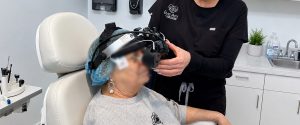
A binocular vision assessment using Neurolens technology may be part of an Eye Am exam. Your optometrist measures the misalignment between your eyes and assesses your visual system's ability to sustain near work.
When a binocular vision imbalance is identified, Neurolens lenses may be recommended to compensate for the misalignment using a contoured prism integrated directly into the lens. Your optometrist will also guide you toward practices suited to reducing everyday eye strain.
Dry AMD, Why Early Detection Supports Better Care
Dry age-related macular degeneration (AMD) mainly affects older adults. According to Fighting Blindness Canada, AMD in its different forms affects approximately 2.5 million Canadians. It can progress silently before central vision begins to deteriorate. Early detection makes it possible to establish appropriate monitoring and care.
Learn more: read our article about dry AMD treatment in Canada.
What Eye Am Does Differently
An Eye Am exam may include high-definition retinal imaging that can identify subtle changes in the macula before they become noticeable in everyday life.
When required, your optometrist can work with an ophthalmologist to confirm the diagnosis and establish a care plan. Eye Am offers MacuMira, a Class II medical device licensed by Health Canada under licence number 108571. This non-invasive treatment uses low-level microcurrent stimulation. Its indication and expected outcomes must be assessed individually with an eye care professional.
One Place to Screen for and Manage Several Eye Conditions
In addition to comprehensive exams, our optometrists use technologies that can detect certain eye conditions before noticeable symptoms appear. In one location, we provide vision assessment, eye alignment analysis and screening for conditions such as glaucoma, AMD and dry eye.
You leave with a clear understanding of your eye health and, when needed, a concrete care plan.
Sources:
- Caffery B. et al. Prevalence of dry eye disease in Ontario, Canada: A population-based survey.
- Scheiman M. et al. Interventions for convergence insufficiency: a network meta-analysis.
- Fighting Blindness Canada. Age-Related Macular Degeneration.
- Health Canada. Active licence for the MacuMira System, no. 108571.
For a comprehensive assessment of your eye health, book an appointment at one of our four clinics in Quebec City, Dorval, Boucherville or Technopôle Angus in Montreal.
Book an Eye Care AppointmentWritten by the Eye Am team